Businesses that sell products or services across multiple states often need to estimate the amount of sales tax they owe. This calculation may be necessary when preparing tax returns, reviewing compliance obligations, or evaluating potential exposure from prior transactions.
Estimating sales tax owed requires analyzing sales activity, determining which transactions are taxable, and applying the appropriate tax rates.
Understanding how to estimate sales tax liability helps businesses maintain accurate reporting and avoid compliance issues. If you are unfamiliar with sales tax exposure, begin with the guide How Businesses Create Sales Tax Exposure.
What Sales Tax Owed Means
Sales tax owed refers to the total amount of tax a business must remit to state tax authorities based on taxable sales. This amount is calculated during each tax reporting period and must be paid when filing sales tax returns.
Sales tax owed may include
- Tax collected from customers
- Adjustments for refunds or returns
- Corrections for previous reporting errors
Businesses must calculate the amount owed for each jurisdiction where they have nexus.
Step 1: Identify Taxable Sales
The first step in estimating sales tax owed is identifying which transactions are taxable.
Some transactions may qualify for exemptions such as
- Wholesale transactions with resale certificates
- Certain services exempt under state law
- Sales to tax exempt organizations
Separating taxable sales from exempt transactions ensures accurate tax calculations.
Step 2: Determine Nexus States
Businesses must determine where they have nexus before calculating sales tax liability.
Nexus may arise through
- Economic nexus thresholds
- Inventory stored in warehouses
- Employees working in another state
- Marketplace or ecommerce sales activity
Once nexus exists, businesses must calculate sales tax owed for transactions in that state.
To review nexus thresholds across states, visit Economic Nexus by State.
Businesses can estimate nexus exposure using the economic nexus calculator.
Step 3: Apply the Correct Tax Rates
Sales tax rates vary by location and may include multiple components.
These may include
- State sales tax
- County tax
- City tax
- Special district tax
Businesses must apply the correct combined rate based on the customer’s location.
Automation tools are often used to calculate these rates accurately.
More details about tax calculations are explained in How to Calculate Sales Tax Liability.
Step 4: Calculate the Total Tax Owed
After identifying taxable sales and applying tax rates, businesses can calculate the total amount of sales tax owed.
This calculation typically involves multiplying the taxable sales amount by the applicable tax rate for each jurisdiction.
Businesses operating in multiple states must calculate tax liability separately for each state.
Adjustments such as refunds or credits should also be included when calculating the final amount owed.
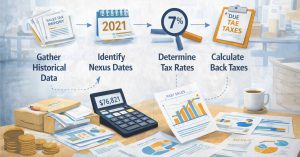
Estimating Historical Sales Tax Owed
Some businesses estimate sales tax owed to determine potential exposure from prior periods.
This analysis may involve reviewing historical sales records and applying applicable tax rates.
Businesses that discover unpaid tax liabilities may need to evaluate compliance options. The sales tax exposure calculator can help estimate potential liabilities.
Preventing Calculation Errors
Incorrect tax calculations may lead to compliance issues.
Common errors include
- Applying incorrect tax rates
- Failing to identify taxable transactions
- Misreporting revenue by state
- Missing nexus thresholds
Maintaining accurate sales records and monitoring nexus obligations helps reduce calculation errors.
Businesses that automate tax calculations often reduce compliance risk significantly.
More details about automation tools are explained in How Sales Tax Automation Software Works.
Related Sales Tax Resources
If you are evaluating sales tax obligations for your business, you can start with the Economic Nexus Guide and review requirements in the Economic Nexus by State reference.
Businesses assessing potential liability often begin with a Sales Tax Exposure Analysis or estimate exposure using the Sales Tax Exposure Calculator.
If you operate across multiple states, the Economic Nexus Tracker can help monitor when thresholds may be triggered.
For a structured overview of potential liabilities, businesses may review the Sales Tax Risk Report.
You can estimate multi-state liability using the Sales Tax Liability Estimator or calculate past obligations with the Back Sales Tax Calculator.
For a detailed breakdown, businesses may also review the Sales Tax Liability Estimate Report.
FAQs
What does sales tax owed mean?
Sales tax owed is the amount of tax a business must remit to the state based on taxable sales.
How do businesses estimate sales tax owed?
Businesses identify taxable sales, apply tax rates, and calculate liability for each jurisdiction.
Do businesses calculate tax owed for each state?
Yes businesses calculate sales tax liability separately for each state where nexus exists.
Can businesses estimate tax owed from past sales?
Yes businesses may review historical sales records to estimate unpaid tax exposure.
How can businesses avoid tax calculation errors?
Businesses should track sales activity accurately and monitor nexus thresholds.